Style Guide
For most written content, including all public-facing marketing material, patient education, internal communications, press releases, and websites, Cooper Norcross Health uses the Associated Press Stylebook as a guide, with a few “house style” exceptions. Below is a quick reference for some common usage questions.
Commas and Semicolons
In an exception to AP Style standards, Cooper uses the serial/ Oxford comma. Example: Symptoms include pain, fatigue, nausea, and dizziness.
Semicolons can be used in sentences that have two separate clauses. They can be used in place of conjunctions (but, for, and), transitional phrases (on the other hand, for example) or periods. Example: The facility is undergoing renovations now; it will reopen in July.
Semicolons can also be used in lists where one or more items contain commas. In these cases, it is appropriate to use a serial semicolon before the last list item. Example: The symptoms of COVID-19 can include fever, chills or fatigue; cough or sore throat; new loss of taste or smell; and muscle, body or headaches.
Time Format
Times are listed with a.m. and p.m., only using the XX:XX format when times are not on the exact hour. Example: 10 a.m. OR 10:30 p.m.
Time ranges indicate a.m. and p.m. at the beginning time only when necessary for clarification. Example: 10 a.m. – 10 p.m. OR 10 – 11 a.m.
Phone Numbers
Phone numbers use periods rather than hyphens and follow the format 000.000.0000. When a phone number includes words, the full numerical listing should follow it; e.g., 800.8.COOPER (800.826.6737).
Hyphens
Hyphens are most commonly used when two or more modifier words precede a noun. Note that if these modifiers come after the noun, a hyphen should not be used. Example: Please use this how-to guide to prepare for surgery. We are publishing a full-page ad in the newspaper.
Do not use a hyphen with adverbs ending in “ly” or including “very.” Example: The brightly lit waiting room is comfortable for patients and their families. (NOT: The brightly-lit waiting room).
Number Formats
Always use numerals for addresses, phone numbers, ages, dates, times, dimensions, temperatures, and weights. Example: You should get screened for colon cancer after age 45.
Spell out numbers below 10 unless they fall under another rule. Example: Cooper has three outpatient surgery centers and more than 130 primary and specialty care offices.
Spell out numbers at the start of sentences. Example: Twenty percent of U.S. adults have experienced mental illness.
Percentages expressed within a sentence should use the % sign. Example: Cigarette smoking is responsible for 80-90% of lung cancer deaths in the United States.
Dates should be expressed as a numeral alone, with no suffix. Example: We are having the ribbon-cutting ceremony on March 1.
Abbreviations and Acronyms
Full titles must be used before an abbreviation or acronym, followed by the abbreviation in parentheses. Example: The Centers for Disease Control and Prevention (CDC) recommends screening starting at age 45. A CDC study demonstrated the value of early diagnosis.
When a registered trademark symbol (® or ™) is necessary, use in the title and upon first mention in the body copy, then leave off for the rest of the content.
Spelling and Word Use
When there are multiple accepted spellings for services and treatments, please refer to this list of Cooper-specific spellings to use:
- Co-CEO.
- Health care.
- Board certified when used alone as a descriptor (e.g., She is board certified).
Board-certified when used to modify a noun (e.g., He is a board-certified physician). - Dietitian.
- Discectomy.
- Orthopaedics.
- Preventive care.
- Telehealth, telemedicine.
Capitalization
Titles and section headings use title case. All verbs and all words of four or more letters are capitalized. Articles, conjunctions, and prepositions of three or fewer letters are not capitalized. Example: Cooper Is Honored With the Forbes Best Employer Award in 2025.
Body copy uses sentence case with proper punctuation. Example: Cooper offers health care services at locations throughout South Jersey.
Only proper nouns (names, company titles, official program titles) are capitalized within body text. Example: Cooper’s community health resources include free health screenings. In addition, the Community Health Worker (CHW) program can help you overcome barriers to your health goals.
Department names are capitalized when used as proper nouns (Example: Please contact Human Resources for more information) but are lowercase when referred to as common nouns (Example: Reach out to the human resources department to learn more).
Credentials and Titles
All credentials are listed without periods between each letter and commas after the name and after each credential. Example: Rebecca Black, DO, MPH, received the award.
Official job titles are capitalized before and after a name: Examples: Chief of Surgery Jane Jones, MD. Jane Jones, MD, Chief of Surgery at Cooper University Health Care.
Descriptive titles are not capitalized. Don Smith, MD, is a primary care physician at Cooper.
Format Consistency
Formatting must be consistent throughout the whole document for clarity and readability. Examples:
- Locations or practice names follow alphabetical order throughout the document.
- Bullet points use periods at the end of each phrase.
- Contact information is listed in the same order every time.
- Headings and subheadings follow the same style throughout the document.
Editorial Citations
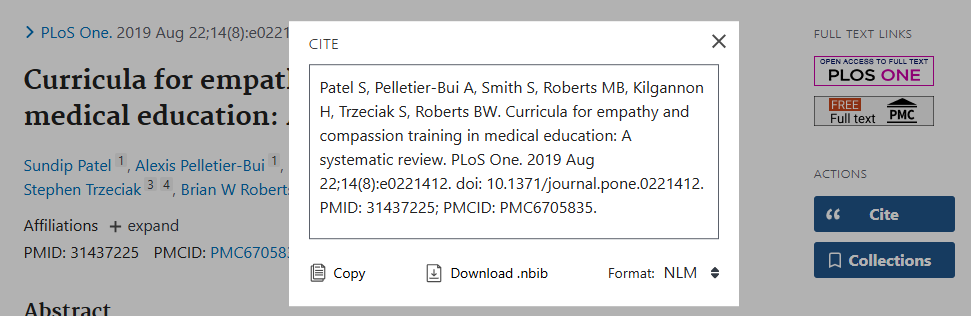
For editorial citations for journal articles, please use the National Library of Medicine (NLM) citation style. An easy way to guarantee the citation is formatted correctly is to use PubMed to look up the article, click the “Cite” button on the right, and choose NLM in the bottom left corner when the citation box appears. Then just copy and paste.